Understanding whether calcium oxide cao is ionic or covalent is fundamental for professionals in the non-metallic mining and manufacturing sectors. This distinction determines how the material behaves under thermal stress, its reactivity with water, and its overall utility in industrial refining and construction.
From a global perspective, the chemistry of calcium oxide—commonly known as quicklime—drives multi-billion dollar industries ranging from steel manufacturing to environmental waste treatment. When we analyze if calcium oxide cao is ionic or covalent, we are essentially decoding the strength of the bond between calcium and oxygen, which dictates the compound's high melting point and caustic nature.
For engineers and procurement specialists, grasping the ionic nature of CaO allows for better predictions of material purity and reaction efficiency. By focusing on the electronic transfer that defines why calcium oxide cao is ionic or covalent, companies can optimize their chemical processes and ensure higher safety standards in the handling of these caustic minerals.
The Chemical Nature of Calcium Oxide Bonding
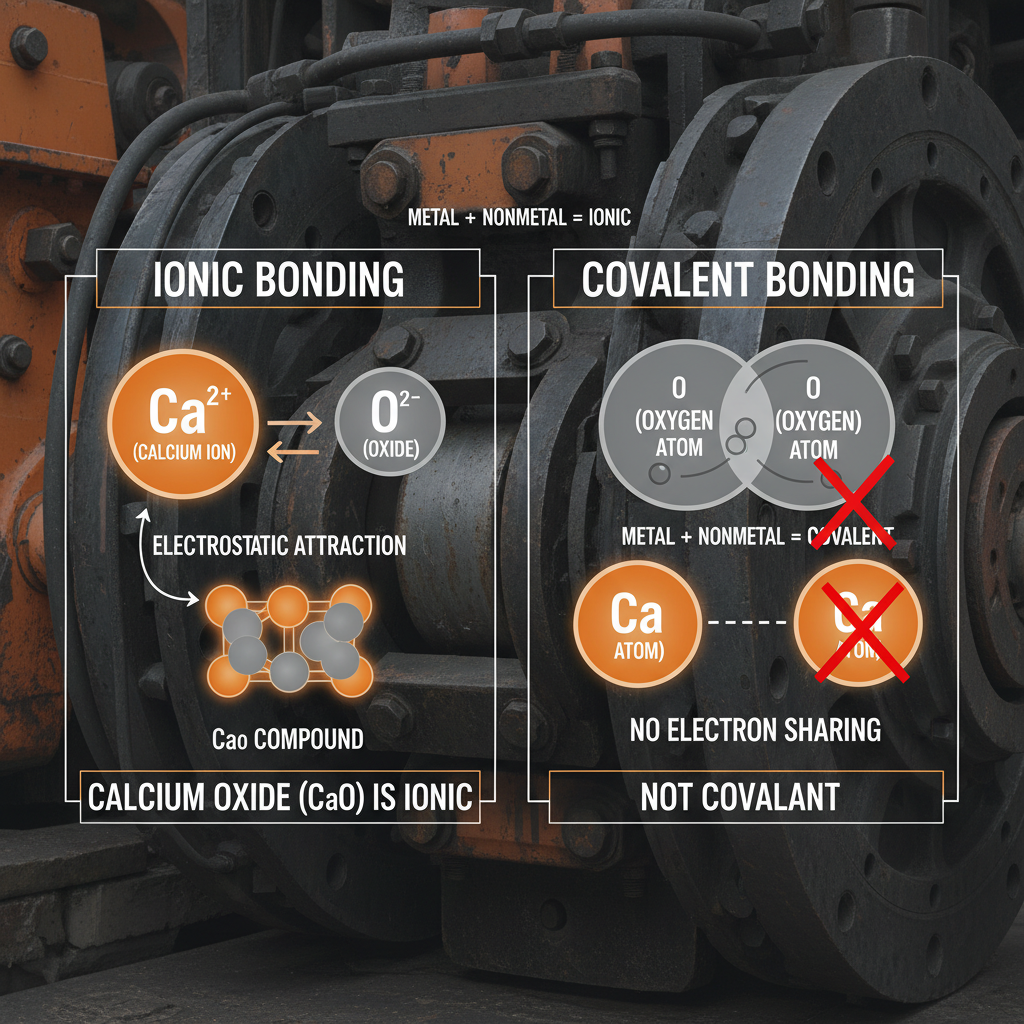
When debating whether calcium oxide cao is ionic or covalent, the answer lies in the total transfer of electrons from the calcium atom to the oxygen atom. Calcium, an alkaline earth metal, easily relinquishes two valence electrons to achieve a stable configuration, while oxygen, a highly electronegative non-metal, readily accepts them.
This complete transfer creates $\text{Ca}^{2+}$ and $\text{O}^{2-}$ ions, which are held together by powerful electrostatic forces. Because the bond is characterized by this attraction between oppositely charged ions rather than the sharing of electrons, the scientific consensus confirms that calcium oxide cao is ionic.
Electronegativity and Bond Classification
To technically determine if calcium oxide cao is ionic or covalent, chemists look at the electronegativity difference ($\Delta\chi$) between the two elements. Calcium has a very low electronegativity, whereas oxygen is one of the most electronegative elements on the periodic table.
A large difference in electronegativity (typically greater than 1.7 on the Pauling scale) indicates that the electrons are not shared equally, but are instead shifted almost entirely toward the oxygen. This gap is so significant in the case of CaO that it eliminates the possibility of a covalent bond.
Consequently, the molecular structure isn't a discrete "molecule" but a crystal lattice. This lattice structure is a direct result of the fact that calcium oxide cao is ionic, ensuring that every ion is surrounded by others of the opposite charge to maximize stability.
Physical Properties Derived from Ionic Bonding
The high melting point of quicklime is a primary indicator that calcium oxide cao is ionic or covalent. With a melting point exceeding 2,500°C, the material demonstrates the immense energy required to break the electrostatic attractions of an ionic lattice.
Furthermore, the solubility and reactivity of CaO in water are governed by the fact that calcium oxide cao is ionic. When exposed to moisture, the ionic bonds allow for a rapid exothermic reaction, forming calcium hydroxide, which is essential for soil stabilization and water treatment.
Unlike covalent compounds, which can be volatile or gas-phase at low temperatures, the solidity and brittle nature of CaO confirm that calcium oxide cao is ionic. This structural rigidity makes it an ideal refractory material for high-temperature furnaces.
Industrial Performance Metrics of CaO
In industrial settings, the performance of calcium oxide is measured by its reactivity and purity. Because calcium oxide cao is ionic, its ability to act as a chemical flux in steelmaking is highly efficient, as the ions can interact rapidly with impurities like silica and phosphorus.
The stability of the ionic bond also ensures that CaO remains a reliable desiccant. Its capacity to absorb moisture is a direct result of the ionic affinity between the calcium cation and the polar water molecule.
Efficiency Analysis of Calcium Oxide Bonding Types
Global Applications of Calcium Oxide
Across the globe, from the mining hubs of Australia to the industrial zones of China, the fact that calcium oxide cao is ionic makes it indispensable for the production of cement and glass. The ionic interaction allows it to act as a powerful stabilizer in the manufacture of high-quality silicate glass.
In environmental engineering, the ionic nature of CaO is leveraged for flue-gas desulfurization. Power plants utilize the high reactivity of these ionic bonds to capture sulfur dioxide emissions, thereby reducing acid rain and protecting global ecosystems.
Sustainability and Environmental Impact
As the industry moves toward "Green Mining," understanding why calcium oxide cao is ionic or covalent helps in developing carbon capture and storage (CCS) technologies. The mineralization of $\text{CO}_2$ into calcium carbonate is an ionic process that permanently sequesters carbon.
By optimizing the calcination process, manufacturers can reduce the energy required to produce CaO. This is critical because the energy used to break the initial bonds in limestone is a significant source of industrial $\text{CO}_2$ emissions.
Furthermore, the use of calcium oxide in soil remediation demonstrates a sustainable approach to agriculture. The ionic properties of CaO help neutralize acidic soils, improving crop yields in depleted regions of Sub-Saharan Africa and Southeast Asia.
Comparative Analysis of Oxide Bonding Types
When comparing calcium oxide to other oxides, such as silicon dioxide ($\text{SiO}_2$), the difference becomes clear: while $\text{SiO}_2$ is a network covalent solid, calcium oxide cao is ionic. This is why quartz is chemically inert compared to the highly reactive nature of quicklime.
This contrast explains why the industrial handling of CaO requires strict safety protocols. The ionic nature makes it highly caustic to human skin and eyes, as it reacts instantly with moisture to release heat and hydroxide ions.
In the realm of non-metallic minerals, the shift from covalent to ionic character generally correlates with an increase in melting point and a decrease in solubility in non-polar solvents.
Comparison of Calcium Oxide vs Other Mineral Oxides
|
Mineral Oxide
|
Bonding Type
|
Melting Point Level
|
Reactivity Grade
|
| Calcium Oxide (CaO) |
Strongly Ionic |
Extremely High |
Very High (Caustic) |
| Silicon Dioxide ($\text{SiO}_2$) |
Covalent Network |
High |
Low (Inert) |
| Aluminum Oxide ($\text{Al}_2\text{O}_3$) |
Mixed Ionic-Covalent |
Very High |
Moderate |
| Magnesium Oxide (MgO) |
Strongly Ionic |
Extremely High |
High |
| Iron (III) Oxide ($\text{Fe}_2\text{O}_3$) |
Predominantly Ionic |
High |
Moderate |
| Zinc Oxide (ZnO) |
Ionic with Covalent Character |
Moderate-High |
Moderate |
FAQS
In simple terms, calcium oxide is ionic. This means that the calcium atom completely gives away its valence electrons to the oxygen atom, creating a strong attraction between a positive calcium ion and a negative oxygen ion, rather than sharing electrons as covalent bonds do.
Because calcium oxide is ionic, it forms a giant crystal lattice. The electrostatic forces holding these ions together are incredibly strong, requiring a massive amount of thermal energy to break, which results in an exceptionally high melting point (above 2,500°C).
The difference lies in the bonding. Silicon dioxide is a covalent network, which is very stable and inert. Calcium oxide is ionic, making its bonds more susceptible to attack by polar molecules like water, leading to the rapid and exothermic formation of calcium hydroxide.
Yes, its ionic nature contributes to its caustic properties. When CaO contacts moisture on the skin or in the eyes, it reacts immediately to form a strong base (calcium hydroxide) and releases significant heat, which can cause severe chemical burns.
While almost entirely ionic, in extremely high-temperature gas phases or under extreme pressure, some degree of electron sharing may occur. However, for all industrial and standard chemical applications, it is classified strictly as an ionic compound.
You can prove it by testing its conductivity in a molten state. Ionic compounds conduct electricity when melted because the ions are free to move, whereas covalent compounds generally do not. Additionally, its high melting point and solubility in water are strong indicators of ionic bonding.
Conclusion
To conclude, the scientific evidence overwhelmingly proves that calcium oxide cao is ionic, a fact that dictates its high melting point, crystal lattice structure, and extreme chemical reactivity. From the atomic transfer of electrons to its macroscopic industrial behavior, the ionic bond is the defining characteristic that makes quicklime an essential tool in mining, steel production, and environmental protection.
As we look toward the future of sustainable mineral processing, understanding these fundamental chemical properties will allow us to innovate more efficient carbon capture methods and safer handling protocols. For those seeking high-purity mineral oxides and professional technical support, we invite you to explore our industrial solutions. Visit our website: www.baifengmining.com